SCALAN vs. No-Code Workflow Tools: Why Process Documentation Makes the Difference

Your HR manager knows the internal policies. Your service team knows how to handle complaints. Your sales team can explain when a quote requires additional approval. These are the very people who possess the knowledge required for effective automation.
Nevertheless, they are often unable to translate this knowledge into automated workflows themselves. In visual workflow tools, they have to grapple with nodes, connections, conditions, and data mapping. This representation alone creates a barrier: those responsible for business processes want to be able to design them in their own language.
SCALAN makes exactly that possible. You describe the process in plain, understandable text. This description serves as the executable routine for your AI agent while remaining the foundation for review, collaboration, and future updates.
This results in three closely linked benefits: Business users can create their own agents. Colleagues and managers can understand the workflow, and ongoing maintenance requires significantly less effort in terms of translation and coordination.
A graphical interface alone does not make automation accessible to business users
No-code promises automation without programming. However, the absence of source code does not automatically eliminate the technical mindset required to build a workflow.
Even in a visual editor, someone must translate a business process into the tool's logic: Which steps are connected? Which condition controls which branch? What data does the next block require? What happens if a value is missing?
For people who model such workflows, a graph is a helpful representation. For business users without this background, it remains an additional language they must first learn. Their actual process knowledge is not enough to work within this interface.
The hurdle begins even before the first automation. A service manager looking at a screen full of nodes and connecting lines does not immediately recognize their daily work. They are forced to engage with a technical representation, even though they simply want to define how their team should handle customer inquiries.
As long as business users have to translate their knowledge into the mindset of a workflow editor, independent automation remains difficult for them to access.
In SCALAN, you work with the language of your department
SCALAN starts directly with your process knowledge. You describe what needs to be done, which rules apply, what information is required, and when a human needs to make a decision.
An AI assistant supports you through a structured interview. It asks about goals, edge cases, and approvals, helping you develop a clear routine. The process is similar to a task business users are already familiar with: explaining to a colleague how a procedure should be handled.
A simplified routine for customer service could look like this:
Check the incoming complaint and retrieve the associated order data. If information regarding the purchase date or the affected product is missing, prepare a follow-up request. Evaluate the case based on our complaint policy. For clear-cut cases, create a draft response. For cases outside the policy, submit them to the service manager for a decision. Do not send any messages without approval.
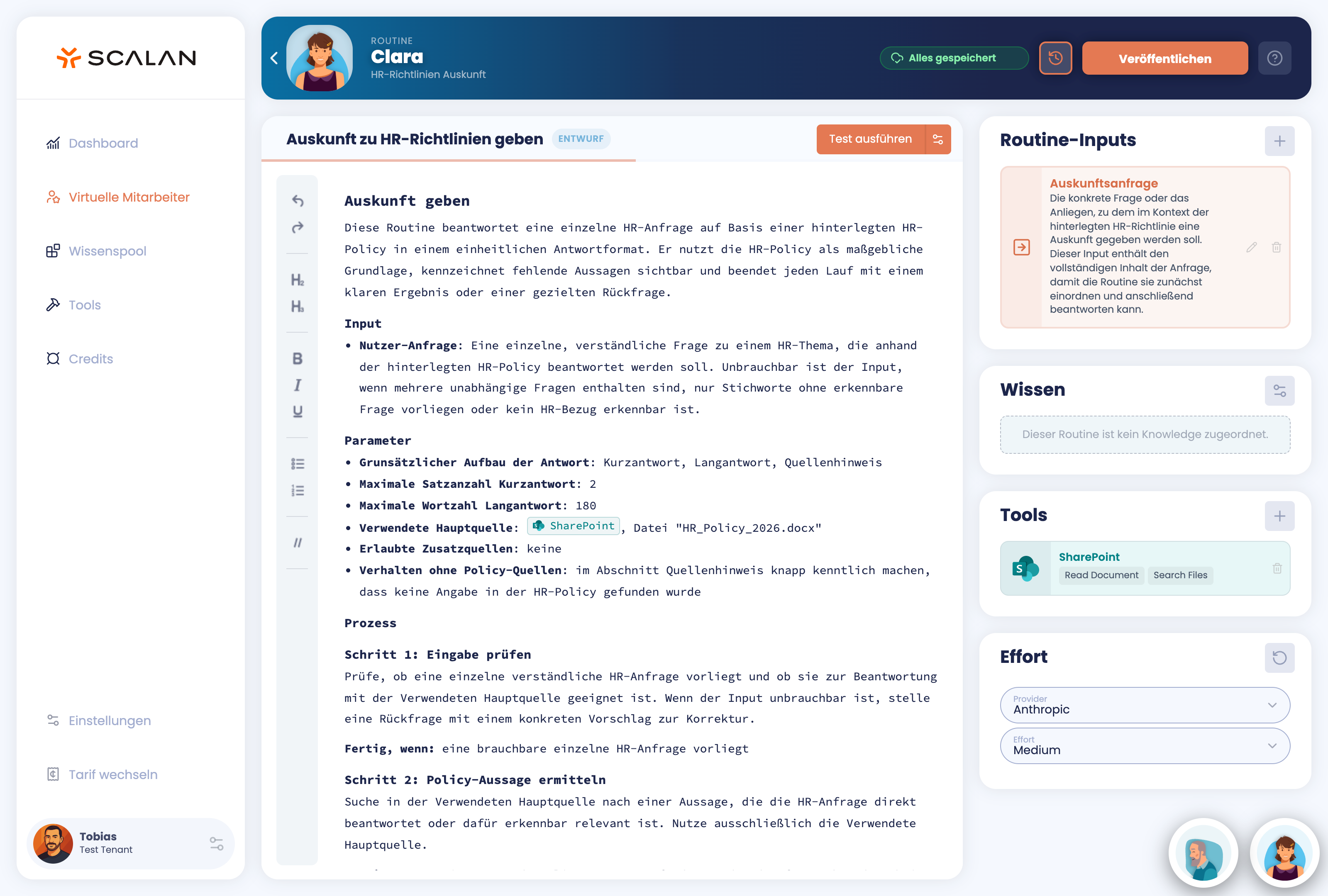
The responsible specialist can read, evaluate, and edit this description. They do not need to create branches in a diagram or delve into the configuration of individual nodes.
The process description is the automation. It remains as readable text and is used when the agent is executed. There is no need to understand or adjust a separately generated workflow graph for functional maintenance.
This makes expert knowledge immediately usable: the person who knows the process can also shape the agent's behavior.
The process becomes understandable for the entire team
The text format also changes who can follow an existing workflow.
A graphical workflow shows its technical structure. To understand the complete functional process from it, a viewer must know the meaning of the building blocks, their settings, and their connections. The visible boxes alone do not explain all the rules implemented within them.
A SCALAN routine describes the process in understandable language. This allows people who did not create the agent to participate as well:
- A colleague checks whether an important exception has been taken into account.
- The department head assesses whether the described steps align with internal policy.
- A substitute reads up on which cases the agent handles itself and when it escalates.
- A successor takes over functional maintenance using the same description.
The process becomes shared, understandable knowledge within the company. Its functional logic is not tied to the person who is familiar with the automation tool.
This also facilitates coordination: all stakeholders can discuss the same specific rule and look directly at the relevant passage of text. An additional explanation of the node graph is not required for this. Referenced expert knowledge and connected systems can be checked additionally if necessary.
Readability reduces ongoing maintenance effort
In everyday operations, policies, responsibilities, approval limits, and exceptions change. The effort required for automation therefore depends significantly on how easily these changes can be implemented.
If only a specialist understands the existing workflow, even a small functional change begins with a handover. The department explains the new requirement. The specialist checks the process and translates the requirement into technical adjustments. Subsequently, the department must assess whether the result matches their intent. Queries and corrections prolong this process.
In SCALAN, the responsible specialist edits the relevant section directly in the routine. Afterward, they verify the changed behavior with test cases and publish the new version.
Suppose your claims policy requires a photo for transport damage in the future. The additional rule could be:
For a reported transport damage, check whether a photo is available. If it is missing, prepare a follow-up request and only continue the functional review once the required information is available.
The specialist can add the rule themselves. A colleague can proofread it. Both can use suitable test cases to verify whether the agent reacts as desired.
The maintenance advantage arises in several areas: There is no need to familiarize yourself with a technical representation to make business-related changes. Fewer handovers are required between the business department and the implementation team. Rules do not need to be updated in parallel in both process documentation and a separately maintained graph. And when staff changes, the workflow remains readable.
This is how SCALAN reduces the effort required for business changes and the dependency on individual specialists. New system integrations and additional action permissions remain tasks for IT. Changes within the existing framework can be handled by the business department itself.
Why a workflow from a prompt is not yet the same thing
Other platforms also support natural language. The n8n AI Workflow Builder can create and modify workflows based on descriptions. In doing so, it selects and configures nodes and connects them into a workflow. Source: n8n documentation
For accessibility, the result of this creation process is what counts: Can your team read and verify the resulting process themselves? Or do they still require knowledge of the structure and configuration of the generated workflow?
In SCALAN, the understandable description itself remains the primary tool – during creation, during collaborative review, and for every subsequent business-related change. Access via language thus continues throughout the entire lifecycle of the agent.
The differences in everyday work
The following comparison refers to working in graphical workflow editors like those of n8n and Make versus the business routine in SCALAN.
Readable routines meet process-compliant execution and centralized control
SCALAN combines this approach with an Operating platform for individual AI agents. Agents can plan intermediate steps, evaluate information, and use authorized tools within defined goals, capabilities, and permissions. In the event of unexpected results, they can choose permissible alternative paths or involve a human.
SCALAN is an AI harness, specifically designed for the productive use of AI agents in business processes. The agentic execution loop was deliberately developed for high process compliance. The execution control is designed to adhere to the described routine and its rules during processing. Test cases help you verify this behavior even in edge cases.
IT centrally defines which systems, actions, and models are available. Business departments create and maintain their agents within these boundaries. Executions and costs are transparent; if necessary, you can pause agents or stop running processes.
Workflow platforms also offer agentic functions today. Make, for example, enables AI agents with instructions, knowledge, and tools within its scenarios. Source: Make documentation
SCALAN's strength lies in the connection: Business users can describe and understand the behavior themselves, while IT provides the mandatory framework for operations.
Why this matters, especially for SMEs
When a small IT team supports many departments, every additional coordination effort becomes a capacity issue. If all business-related changes must be implemented by IT or an external service provider, the ongoing maintenance grows with every new automation.
SCALAN enables a different division of labor. Departments contribute their knowledge directly into executable routines, review them together, and keep them up to date. IT focuses on integrations, permissions, and secure operations.
This makes automation accessible to more people in the company and ensures it remains understandable even when responsibilities change. It creates the foundation to operate multiple use cases long-term without having to schedule specialists for every business adjustment.
If you want your departments to create, understand, and further develop AI agents themselves, SCALAN is designed exactly for this way of working.
Test it with a process from your company: Have the responsible specialist create a routine, explain the workflow to a colleague, and then add a new rule. This will show you the difference a readable process description makes in everyday work.