AI Harness: What it is and why AI agents won't get far without it

AI agents often appear remarkably autonomous from the outside. They read documents, call tools, make intermediate decisions, and complete tasks over multiple steps. In practice, however, a different question is crucial: What ensures that a model doesn't just respond, but acts in a controlled, secure, and transparent manner?
That is exactly what the AI Harness is for. It refers to the layer surrounding the model that organizes goals, context, rules, tool usage, and states. Without this layer, a language model remains primarily a very powerful generator. With it, it becomes an agent that can actually work reliably in business processes.
If you want to understand why some agents impress in demos but fail in everyday use due to long tasks, a lack of transparency, or messy tool calls, you need to understand the harness. It is not the model. It is the operational and control layer that embeds the model into a robust working context.
AI Harness explained simply
An AI Harness is the control and infrastructure layer that connects an AI model with rules, context, tools, states, and checkpoints. The model handles the reasoning. The harness regulates what information the model is allowed to see, which actions are permitted, and how results are processed further.
In short: The model provides the linguistic or logical capability. The harness turns it into a system that is truly executable.
A simple image is often more helpful than any definition. The model is the engine of a vehicle. The harness is the chassis, the transmission, the fuel tank, the lights, and so on—everything that belongs to a vehicle except the engine. Only this interaction turns a single response into a robust agent process.
That is why, in practice, it is not just model quality that counts. Even a powerful LLM will not execute processes stably if context is lost, tools are poorly integrated, or security-relevant actions are not properly restricted.
AI Harness vs. Prompt Engineering: What is the difference?
Many teams start with prompt engineering. This makes sense because good instructions can significantly improve the quality of individual responses. However, for productive AI agents, that is not enough.
Prompt engineering deals primarily with the formulation of inputs to the model. Context engineering determines what information is actually available to the model at any given moment. Harness engineering goes one step further. It designs the execution environment around the model.
That is exactly where the difference lies. A good prompt can say what the agent should do. A good harness additionally defines which tools can be used, how errors are handled, when a human must intervene, what information is stored permanently, and how the process can be audited later.
As soon as an agent handles more than just a single request, the focus shifts. It is no longer just about response quality; it is about process quality.
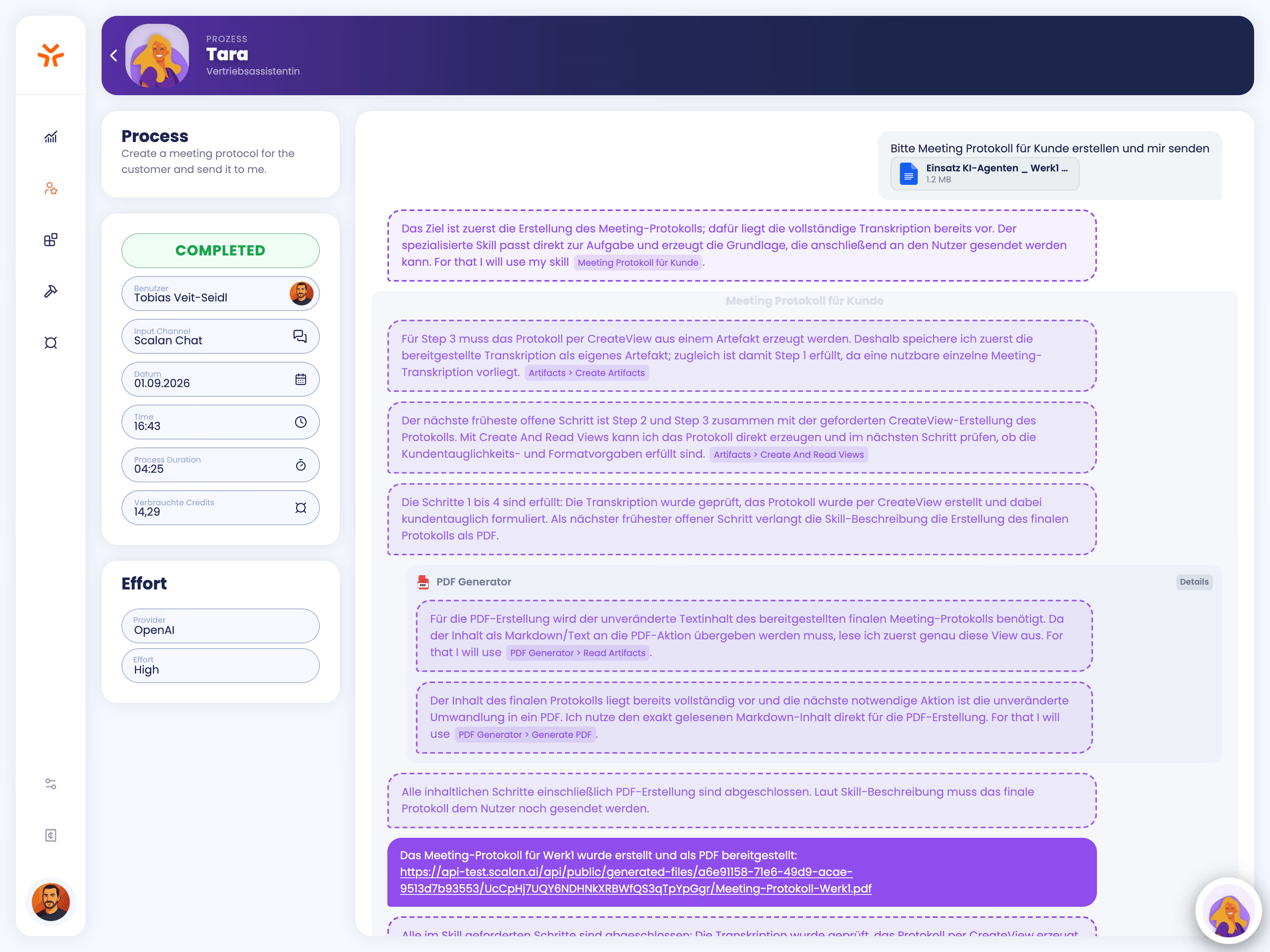
In the image: SCALAN is an AI Harness that supports Explainable AI and makes AI agents transparent.
Why AI agents fail without an AI Harness
Without a harness, an agent lacks the binding environment required for longer and more complex tasks. This often only becomes apparent when you move beyond showing a demo and try to map real workflows.
A typical problem is the loss of the goal during an ongoing process. With long tasks, the context grows with notes, tool results, and intermediate states. Eventually, the original question and priorities are lost from view. The model continues to respond plausibly, but not necessarily in line with the actual goal.
A second problem is messy tool calls. If tools are not clearly registered, validated, and restricted, it leads to incorrect parameters, unclear responsibilities, or simply actions that are not permitted at all. This is not only inefficient but also risky in corporate environments.
Furthermore, there is a lack of persistence. Pure model calls are stateless. After a restart or context switch, progress is quickly lost if no separate layer documents it and makes it available again. This is a central problem, especially for long-running agents.
Costs and security also quickly become unmanageable without a harness. Repeated requests, unnecessary tool calls, a lack of boundaries for actions, or insufficient logging mean that an agent may work formally, but is operationally uncontrollable.
The key components of an AI harness
An AI harness is not a single feature. It consists of several building blocks that work together. The exact nature of these blocks depends on the use case, but the underlying logic usually remains the same.
AI harness in the execution loop
The execution loop controls the agent's ongoing work cycle. It determines how to react to new information, when a tool may be used, when a step is complete, and when a process needs to be paused or re-evaluated.
This loop is crucial, especially for longer tasks. It prevents the agent from working aimlessly or declaring a task finished too early. Instead, it creates a logical rhythm of checking, acting, evaluating, and continuing.
AI harness and tool registry
A productive agent needs tools. These include things like search, database access, file processing, or system actions. The tool registry keeps track of which tools are available, how they are called, and what inputs are permitted.
This sounds technical, but it has direct business relevance. The difference between a useful agent and a risky one often lies right here. Not every model should be allowed to trigger every action. A clean harness gives the agent individually authorized actions rather than blanket access.
AI harness for context management
Context is not just a collection of tokens. What matters is which information is truly relevant for the next step. A harness therefore takes care of providing curated context.
This can include summarizing previous steps, displaying only necessary documents, or accessing external knowledge sources in a targeted manner. This keeps the processing focused and reduces the risk of important information getting lost in the noise.
State store and persistent work status
Long-running tasks require a stable work status that persists beyond individual sessions. A state store records what has already happened, what results are available, and where the agent should resume.
This is more than just a convenience feature. Without such storage, the agent effectively starts from scratch after interruptions or continues working with incomplete assumptions. A good harness therefore secures not just the answers, but the progress of the work itself.
Guardrails, approvals, and human-in-the-loop
As soon as an agent has an external impact, boundaries are needed. Guardrails define what is permissible and what is not. Human-in-the-loop complements these rules with human approvals at critical points.
Precise formulation is key here. A harness can provide approval points and limit actions. However, this does not automatically mean that all regulatory obligations are fully resolved. Supporting infrastructure does not replace responsibility; it simply makes it easier to manage.
Observability and evaluation
For an agent to be viable in a corporate environment, you must be able to track what it has done. Observability provides this transparency. This includes tool calls, relevant intermediate steps, processing logs, and usage data.
Evaluation goes a step further. It assesses whether the behavior is professionally appropriate. Both are important. A fully logged process is not automatically a good one, and a result that sounds plausible was not necessarily achieved through the correct process.
Why the harness is often more important than the model
Many discussions still act as if the model is the main thing. For productive agent operations, that is only partially true. The model remains central, but it is only one part of the overall system. In this video, Y Combinator explains in their VC Paper Club that AI agents reach only 30% on the ARC-AGI test without a harness, but 95% with an optimized harness.
The more reliable question is therefore not: Which model is the most powerful? But rather: In what environment does it operate? What tools are available? How is context provided? How is state maintained? What rules limit its actions? What does the audit trail look like?
This is precisely why model agnosticism is so strategically relevant. If the operational logic resides in the harness, the underlying model can be swapped out or selected based on the specific task without having to rebuild the entire process.
This is not a minor technical detail. It is an operational decision. By doing this, companies are not just investing in model usage, but in a resilient execution logic that can grow with their requirements.
How do you implement an AI harness effectively?
Anyone looking to build an AI harness should not start with maximum complexity. It makes more sense to clearly define the task requirements and then build the control layer step by step.
The first step is always defining the functional scope. What task is the agent actually supposed to handle? Which decisions is it allowed to make, and which are off-limits? What information does it absolutely need, and which actions are permitted?
Next comes the tool side. Tools should not just be technically connected, but also clearly described in terms of their role. An agent doesn't just need to see a tool; it needs to know when it is useful and what results can be reliably processed further.
Equally important is context management. Many agents fail not because of a lack of model performance, but because of unclear context control. If everything is crammed into the window at once, quality drops. If there is too little context, the agent acts with gaps. A harness must therefore select and prioritize.
Next is persistence and logging. Long-running tasks require a documented history so that new sessions can pick up seamlessly. This is exactly where the difference between a demo and a production system becomes apparent.
Finally, there are guardrails, testing, and observability. Only when it is clear how errors become visible, how to trigger interventions, and how to systematically learn from malfunctions does a viable operational framework emerge.
For which companies is an AI harness worth it?
Not every AI application needs a sophisticated harness from the start. If you are only generating individual pieces of content or supporting simple, low-risk responses, a smaller framework is often sufficient.
However, as soon as multiple steps, systems, rules, approvals, or longer processing times come into play, the value increases significantly. This is especially true for companies that want to do more than just experiment and instead map recurring processes cleanly.
This becomes particularly relevant for small and medium-sized enterprises. They often have clear processes, a wealth of domain expertise, and limited IT capacity. In this exact constellation, the division of labor is crucial: departments define and maintain their routines, while IT provides the technical and organizational framework.
A good harness is therefore not just a technical topic. It is also an organizational model. Maintenance does not disappear; it changes hands. Functional adjustments belong where the process knowledge resides. Technical boundaries and approvals remain within the central control layer.
What role does SCALAN play in the AI harness?
When companies want to manage multiple AI agents rather than just building individual ones, a loose collection of prompts and tool connections is usually not enough. You need an overarching framework for creation, maintenance, permissions, traceability, and ongoing operation.
This is exactly where SCALAN fits in: as an AI harness for AI agents in small and medium-sized enterprises with a focus on simple creation and secure operation. For example, the SCALAN execution loop was specifically developed to deploy AI agents very reliably in business processes. The creation process itself has also been tailored to business departments. They simply describe their desired professional routines in plain language, while IT can use SCALAN to define the framework for models, system integrations, roles, and actions.
This is particularly interesting if you want to run multiple use cases cleanly rather than just testing a single AI agent. The value comes not only from execution but also from versioning, transparency, accountability, and controlled development.
It is important to keep the EU AI Act in mind. SCALAN does not relieve companies of their obligations, but it does support them in their operations, for example through traceable workflows, limited actions, and structured accountability. Likewise, an agent does not become good just because a platform exists. The decisive factor remains how clearly the professional routine is formulated and how thoroughly the execution is verified. SCALAN helps here with a guided interview during the AI agent creation process, which ensures a solid foundation is created safely and easily.
AI harness, governance, and secure operation
As soon as agents access corporate knowledge, systems, or external actions, governance becomes mandatory. The harness is the practical translation of this into operations.
It does not guarantee accuracy on its own, but it creates conditions under which rules can be verified and actions can be limited. This includes roles, permitted system actions, logging, cost control, and human intervention at sensitive points.
For companies, this is a key difference compared to purely experimental setups. Without defined governance, an agent remains difficult to scale. With a good harness, processes can be designed so that the results remain clear, even if the path to get there is flexible.
This is precisely why AI explainability and process transparency are not optional extras in this context. Anyone using agents in production must be able to understand how decisions were prepared, which tools were involved, and where potential risks lay.
Is the effort for an AI harness really worth it?
Yes, if an agent is intended to take over recurring tasks with real impact. The additional effort seems greater at first than with a simple prompt setup. In the long run, however, it saves follow-up costs in operation, monitoring, and error handling.
Without a harness, problems are simply pushed down the line. They reappear as unclear results, manual rework, lack of auditability, or rising usage costs. With a harness, you invest in structure earlier, but in return, you get a significantly better foundation for stability, further development, and model switching.
The economic point is therefore not just about tokens or response speed. The decisive factor is whether an agent can be used reliably under real-world conditions. That is exactly what makes the AI harness so important.
AI harness FAQ
What is an AI harness in one sentence?
An AI harness is the control and operational logic surrounding an AI model that organizes context, tools, rules, states, and checkpoints for an AI agent.
Is an AI harness the same as a framework?
No. A framework provides building blocks for development. The harness is the concrete runtime and control layer in which an agent actually operates.
Does every AI agent need an AI harness?
Essentially yes, but not always to the same extent. A simple agent only needs a small framework. As complexity increases, so do the requirements for context management, persistence, rules, and traceability.
What is the difference between prompt engineering and harness engineering?
Prompt engineering improves the instructions given to the model. Harness engineering designs the environment in which the model acts. For production-ready agents, both levels are important, but the harness is often what determines operational reliability.
Why is the AI harness so important for governance?
Because it defines which actions are permitted, how processing steps are made visible, and where approvals or checks are applied. Without this layer, governance requirements often remain abstract.
Can an AI harness be model-agnostic?
Yes, and in many cases, that makes perfect sense. If the execution logic is cleanly separated from the model, it is easier to adapt the underlying LLM later to meet requirements, costs, or quality goals.
Conclusion: The AI harness turns model performance into reliable agent work
A powerful model is important. However, for productive AI agents, it is only one part of the whole. Only the AI harness connects the model, context, tools, rules, and operational logic into a system that is viable for real-world processes.
If you want to deploy AI agents that are not just experimental, but secure, traceable, and maintainable, a harness is essential. That is exactly where the reliability that companies need for productive use is created.
If you want to see how individual AI agents can be built with clear routines, limited actions, and traceable operations, test the AI agent platform SCALAN or request a consultation appointment.

Find out in 15 minutes if an AI agent makes sense for you.